FED-RAMP as it applies to on-premise software
The Federal Risk and Authorization Management Program (FedRAMP) exclusively applies to cloud computing products and services. Because this check-in system is deployed strictly as an on-premise software application running entirely on the agency’s internal, dedicated hardware and infrastructure, it does not meet the National Institute of Standards and Technology (NIST) definition of a cloud service. FedRAMP authorization is intended for commercial cloud service offerings (SaaS, PaaS, and IaaS) where federal data is hosted externally by a third-party provider.
Since this system does not involve an external hosting environment, third-party cloud infrastructure, or multi-tenant remote network access, it falls entirely outside the scope of FedRAMP. Security compliance for this deployment is instead governed by standard Federal Information Security Modernization Act (FISMA) requirements and the agency's internal Risk Management Framework (RMF) to achieve an independent Authority to Operate (ATO).
When deploying an application strictly as an on-premise system, your FISMA compliance strategy changes drastically compared to a cloud environment. Instead of maintaining every security control yourself, your primary objective is to document which controls are locally implemented by your software, and which controls are inherited directly from the agency’s pre-existing, authorized infrastructure.
The generated document provides professional language mapping out tailored, on-premise justifications for several critical NIST SP 800-53 control families:
Key Control Scopes Addressed in the PDF
- Physical Protection (PE-3) & Boundary Protection (SC-7): Fully marked as Inherited. Because the system runs on agency hardware inside a federal building, you inherit their physical guards, badges, perimeter firewalls, and network intrusion detection.
- Account Management (AC-2) & Authentication (IA-2): Formulated as Locally Managed via Inheritance. Explains that the software integrates directly with the agency's internal identity infrastructure (like local Active Directory or LDAP for PIV/CAC cards) and does not call out to external cloud-based identity providers.
- Information Exchange (CA-3) & Configuration Management (CM-2): Outlines that data transmission is strictly confined to the agency intranet/LAN, completely avoiding external internet-facing APIs, while patches are managed entirely via internal agency change controls.
As a completely self-contained system
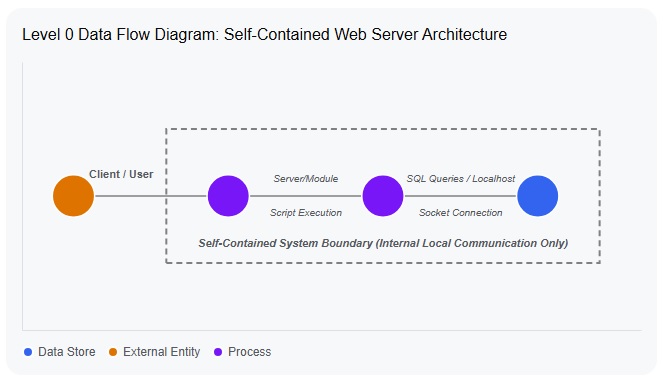
Since your system is completely self-contained, your compliance posture is significantly simplified. You have no external data flows, no secondary database synchronization pipelines, and zero third-party system dependencies to secure or document.
This standalone architecture drastically narrows your attack surface and eliminates the need for complex interconnection security agreements (ISAs). Here is how you can document this self-contained architecture for your internal risk management framework and auditors:
- CA-3 (Information Exchange / Interconnections): Not Applicable / Exempt. The system operates entirely as a localized, standalone application on dedicated agency hardware. It does not interface, synchronize, or establish data connections with any external networks, remote databases, or third-party APIs. All processing and data storage remain strictly local to the authorized system boundary.
- SC-7 (Boundary Protection): Inherited. Because the application does not connect to the broader internet or outside networks, network perimeter defense is fully inherited from the agency’s local network or physical facility isolation. No inbound or outbound internet-facing ports are required for system operations.
- SI-2 (Flaw Remediation / Patching): Locally Managed via Agency Controls. Because the system is self-contained and completely isolated from external update servers, software updates and security patches cannot be pushed automatically over the internet. All maintenance, security updates, and software patches are applied manually by authorized agency administrators via internal change management procedures.
StateRAMP/GovRAMP
StateRAMP (which also operates or is transitioning under the broader banner of GovRAMP) follows the same foundational model as FedRAMP and exclusively applies to cloud computing products and services used by state, local, tribal, and educational (SLTT) entities.
Because your check-in system is deployed strictly as an on-premise, self-contained application on local hardware, it is exempt from StateRAMP for the exact same reasons it is exempt from FedRAMP:
- Target Scope: StateRAMP standardizes security verification specifically for Cloud Service Offerings (CSOs) like SaaS, PaaS, and IaaS where vendor infrastructure handles government data externally.
- Local Deployments: On-premise, air-gapped, or locally hosted software operating entirely inside a state or local agency’s internal environment falls outside StateRAMP's jurisdiction.
- State Equivalents: While some states have strict cloud mandates (such as Texas's TX-RAMP program), those rules only trigger if the product is delivered as a cloud service. Local compliance for on-premise builds is managed via state-level or local agency risk frameworks rather than RAMPs.